Website & Trust
How to write a homepage headline clients understand in 5 seconds
Most homepage headlines say hello instead of saying what you do. Five simple fixes, with before-and-after examples, to help consultants and coaches write a clearer one.
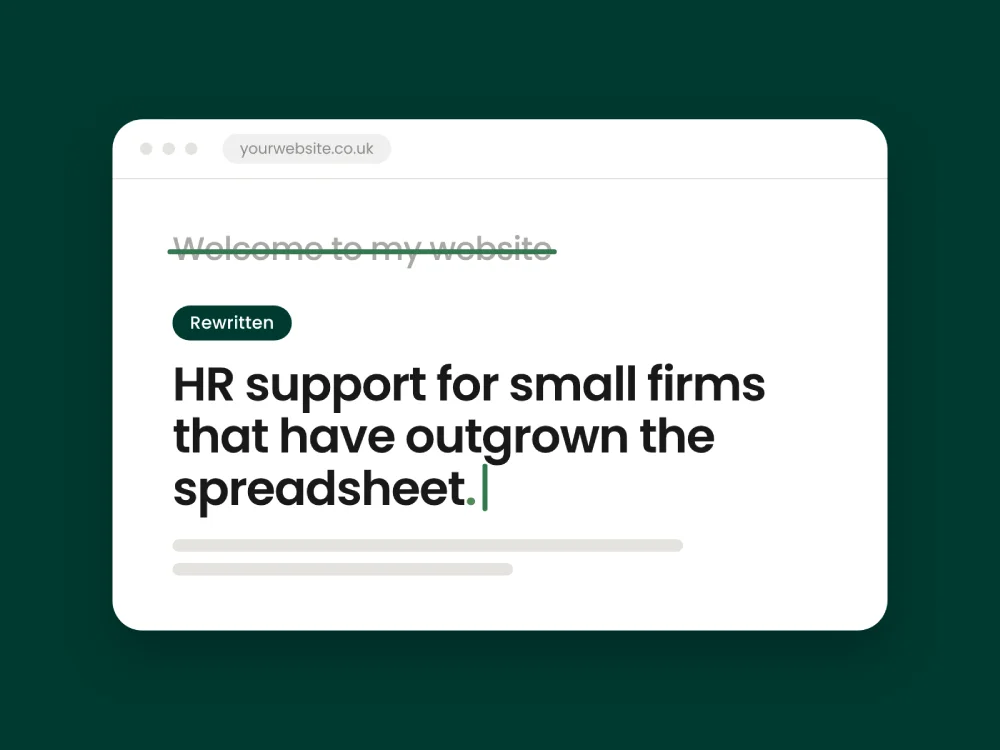
Homepage headlines often get written last, in a hurry, with the designer waiting. That’s a shame, because it’s the line that decides whether anyone reads the rest.
The good news is that you don’t need to be a copywriter. You need a method, and about an hour.
Here’s a simple one, in five steps. To show how it works, we’ll build one headline from scratch for an illustrative client: an independent consultant who helps small architecture practices.
Step 1: Collect your clients’ words
Before you write anything, open your inbox.
Look at the first emails or call notes from clients you loved working with. Copy out the phrases they used to describe the problem, before you’d had a chance to reframe it.
For our consultant, that list might include:
“We’re always busy but never seem to make any money.”
“Every project runs over.”
“I’ve become the bottleneck.”
These phrases are your raw material. They’re exactly what the next client in that situation is thinking.
Step 2: Name who it’s for
Be specific enough that the right person nods and the wrong person quietly moves on.
“Businesses” is too broad. “Small architecture practices” is clear. If you work with a particular size, sector or stage, say so.
So far: small architecture practices
Step 3: Name the situation they want to get out of
Now pick the one problem or outcome that matters most to those people. Use their words from step 1, not your professional vocabulary.
“Improving operational efficiency” is how you’d describe it. “Always busy but never making money” is how they would.
So far: small architecture practices that are always busy but never seem to make any money
Step 4: Cut it down to one sentence
Your first full draft will probably be too long. That’s normal. Here’s what ours might look like:
First draft: I’m an operations consultant with years of experience helping small and medium-sized architecture and design practices improve their processes, profitability and project delivery.
Now cut. Your job title, your experience and your list of services can all live in the subheading or further down the page.
Final: For small architecture practices that are always busy and somehow never profitable
One sentence. Who it’s for, and the situation they recognise. The small twist at the end (“somehow”) is the kind of thing a client might actually say.
Step 5: Give it the five-second test
Show your headline to someone outside your field for about five seconds, then hide it. Ask them two questions:
Who is this for?
What do they get?
Five seconds isn’t a scientific figure. It’s simply a practical stand-in for the quick glance most of us give a website before deciding whether to stay.
If they answer both questions without guessing, you’re done. If not, go back to step 3 and try a different phrase from your list.
A fill-in-the-blanks formula
If you’d like a starting point, try one of these:
For [who] who [situation in their words].
Helping [who] [get the outcome] without [the thing they dread].
[What you do] for [who] who [situation in their words].
Treat them as scaffolding, not a script. Once the sentence makes sense, rewrite it until it sounds like you.
Then let the subheading do the rest
The headline doesn’t need to carry everything. The line underneath can add how you work, what makes you different, or a piece of proof.
The headline’s only job is to make the right person read that next line.
If you already have a headline and suspect it isn’t working, my post on five fixes for your homepage headline covers the most common culprits. (Link to the 5 fixes post.)
Stuck on the last few words?
It’s surprisingly hard to write about yourself. You’re too close to the work to see what a stranger needs to hear.
If you’d like help, I’m happy to look at your homepage with you. It’s a free 20-minute video call, and you’ll come away knowing where I’d start. No obligation.